Against the backdrop of the global aviation industry accelerating carbon emission reduction efforts, Sustainable Aviation Fuel (SAF), as a core pathway to achieving aviation decarbonization, is rising at an unprecedented speed. However, the vigorous development of this green energy source has inadvertently cas a heavy shadow over the oleic acid industry. With raw material competition, soaring costs, and customer loss, the oleic acid industry is facing unprecedented challenges and may even be heading into a winter period.
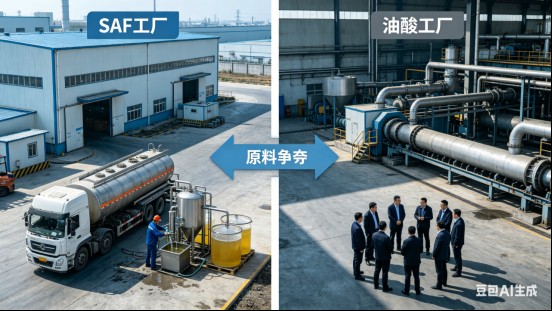
The production of SAF heavily relies on biomass raw materials such as used cooking oil (UCO) and acidulated oils. As global SAF production capacity rapidly expands, demand for these raw materials has surged, sparking a fierce competition for biomass resources. Data shows that during certain periods, the price of used cooking oil has exceeded 14,000 yuan per ton, even surpassing soybean oil prices. This price inversion phenomenon has directly driven up the production costs of oleic acid.
Oleic acid, as an important chemical raw material, is mainly produced through the hydrolysis and refining of animal and vegetable fats and oils. However, with the SAF industry's large-scale procurement of raw materials like used cooking oil and acidulated oils, oleic acid production enterprises are facing dual pressures of raw material supply shortages and rising costs. The once-stable raw material supply chain has been disrupted, forcing companies to compete for limited raw material resources at higher prices, further exacerbating the cost dilemma in the oleic acid industry.
The rise in raw material costs has directly led to a surge in oleic acid production costs. Taking soybean oleic acid as an example, raw material costs account for over 90% of its production costs. With the continuous increase in prices of raw materials like used cooking oil and acidulated oils, the production cost of soybean oleic acid has severely exceeded soybean oil prices. This cost inversion phenomenon has significantly reduced the market competitiveness of oleic acid.
Soybean oil, as a traditional oleochemical raw material, has relatively stable prices and a wide range of downstream applications. In contrast, although oleic acid possesses unique chemical properties and a broad range of applications, its market advantages are gradually being lost under the pressure of high costs. Faced with soaring oleic acid prices, downstream customers have to reconsider their raw material choices, posing a severe challenge to the oleic acid industry.
Facing the continuous increase in oleic acid prices, downstream customers are actively seeking alternative raw materials to reduce production costs. In multiple industries such as plastics, detergents, and mineral processing, where oleic acid serves as a core raw material for emulsifiers, softeners, and flotation agents, its position is being seriously challenged. Downstream customers are modifying their formulas, reducing or discontinuing the use of oleic acid, and turning to other lower-cost and similar-performance raw materials.
For instance, in the plastics industry, some enterprises are beginning to use palm oleic acid and stearic acid as substitutes for oleic acid in the production of plastic modifiers and plasticizers. In the detergent industry, the production of surfactants is also gradually reducing its reliance on oleic acid and turning to other more economical raw materials. This trend of formula modification is rapidly spreading across various downstream sectors of the oleic acid industry, leading to a significant contraction in market demand for oleic acid.
Rising raw material costs, production cost inversion, and loss of downstream customers—a series of adverse factors have converged, placing the oleic acid industry in an unprecedented predicament. If this trend continues, the oleic acid industry may well enter a winter period and even face an existential crisis.
However, crises often breed opportunities. Facing the challenges brought by the rise of SAF, the oleic acid industry must actively seek transformation paths. On one hand, enterprises can strengthen technological innovation to improve raw material utilization efficiency and reduce production costs. For example, by developing new hydrolysis and refining processes, enterprises can increase oleic acid yield and purity while reducing raw material waste. On the other hand, enterprises can explore new application areas and develop high value-added products to enhance market competitiveness. For instance, in high-end fields such as pharmaceuticals and cosmetics, oleic acid has unique application values, and enterprises can increase research and development efforts to launch high-end products that meet market demands.
Additionally, the oleic acid industry can strengthen collaborative cooperation with the SAF industry to achieve resource sharing and complementary advantages. For example, by establishing strategic partnerships with SAF production enterprises, they can jointly develop new raw material sources and production processes to reduce raw material costs and production risks.
The rise of SAF has brought unprecedented challenges to the oleic acid industry but also provides an opportunity for industry transformation. Facing the onset of winter, the oleic acid industry must actively respond and proactively transform to remain invincible in the fierce market competition. Let us look forward to the oleic acid industry breaking through difficulties and ushering in a new spring!
ADDRESS:99 Haiao Road, Nantong Economic and Technological Development Zone, Jiangsu Province
TEL:0086-0513-81056882 81056822 85998195
FAX:0086-0513-85998291
Email:LIZF777@163.COM